The Place-Name Shortcut That Misleads
Place-name origins take more than a word resemblance. Compare historical spellings, pronunciation, and language clues to build a careful account of local names.
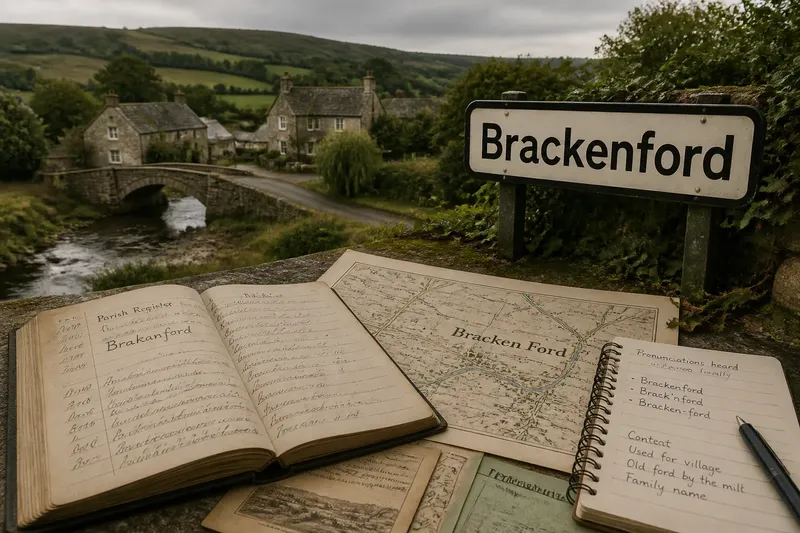
A village sign can make a name look like an ordinary word, but that resemblance may hide a long history of changed sounds and spellings. To investigate place-name origins, trace how the name was recorded and pronounced before settling on what it might mean.
Forms and meanings
A current name is a form people use; an origin is an explanation for how that form developed. A road sign, map, or spoken pronunciation can document a form, but none alone establishes its history.
For example, a name that resembles a familiar English word may descend from another language or have been reshaped by later speakers. The resemblance is a lead to examine, not proof that the place was named for the word’s current meaning.
Historical spellings
Older maps, parish registers, gazetteers, and local archives may preserve forms that differ from today’s spelling. Treat each as a record made in a particular setting: a clerk might have written what a name sounded like, copied an earlier document, or followed the spelling habits of the time.
Compare forms in date order rather than choosing the oldest as the “correct” one. A sequence may reveal sound changes, word division, or administrative spelling, though gaps in the record can leave more than one explanation possible. County archives and local libraries can help identify relevant map collections and catalogues.
Imagine a fictional hamlet called Brackenford, recorded as Brakanford in a parish register and later as Bracken Ford on a map. You note both forms, compare their dates, and check additional local records for intermediate spellings. If none appears, the result is a documented pair of forms and an unresolved question about whether the name’s parts once referred to bracken and a ford.
Sound and language
Historical linguistics—the study of how languages and sounds change—can help test whether a proposed meaning fits a name’s recorded forms. A resemblance to a modern word matters less if the older spellings or known sound changes do not support it.
Names can also contain borrowed or altered elements. People moving, trading, worshipping, and governing across local areas carried words and pronunciations with them; later speakers could adapt unfamiliar sounds to forms they recognized. A familiar ending may have been added to an older stem, or two parts may have entered the name at different times.
Compare neighboring names only when their historical forms and linguistic settings are relevant. Similar spelling by itself does not make one place a reliable translation of another.
Pronunciation and use
Official spelling is only one part of a name’s history. Residents may use a shortened form, pronounce it differently from visitors, or apply it to an area that does not match a map’s boundaries. These habits show how the name functions now; they do not automatically reveal its origin.
If you record local speech, keep the spoken form, the context, and the speaker’s explanation in separate notes. One pronunciation may preserve an older sound, or it may reflect ordinary speech change or a family’s own usage.
A name’s reach can change too. A name once used for a farm, crossing, or estate may later identify a village, road, or wider district. Maps and records can help document that shift, while local speech shows which forms remain in use.
Evidence and decisions
Use the following checks to organize an investigation, not to force a single answer. Each observation points to a next action; when the evidence leaves alternatives open, keep the interpretation qualified.
- Check the current spelling and record any pronunciations you hear; if speakers use different forms, note each one and its context, then avoid presenting one as universal.
- Check dated maps and local records for earlier spellings; if several forms appear, compare their order, and if only one is available, describe the record as limited rather than claiming a clear development.
- Check whether a proposed word meaning fits the older spellings and plausible sound changes; if it fits, present it as a supported possibility, and if it does not, set that explanation aside.
- Check whether the landscape feature invoked by an interpretation appears in older maps or local records; if its past presence is supported, include it as contextual evidence, and if not, leave the link unconfirmed.
- Check whether a proposed element may have come from another language or been adapted by later speakers; if the forms support that possibility, explain the proposed layers, and if they do not, avoid treating a familiar-looking element as settled.
- Check whether the name’s recorded use refers to a farm, settlement, road, or broader area; if the referent changes across records, describe that shift, and if the evidence is sparse, keep the extent uncertain.
Say you are writing a short account of fictional Brackenford and have the parish-register form Brakanford, the later map form Bracken Ford, and a current sign reading Brackenford. First, list the three forms with their sources instead of treating them as interchangeable. Next, compare their dates and check a local archive catalogue for other records; suppose none supplies another spelling. Then note that the modern word “bracken” resembles one part of the name, but the available forms do not establish what the name originally meant. Your account can state the recorded sequence and say that a link to bracken and a ford remains possible, not proven; the tradeoff is a less tidy origin story in return for a clearer distinction between evidence and interpretation.
Questions about names?
Can a place name have more than one origin?
Competing explanations may fit different parts of the evidence, and a name can preserve elements added at different times. If the records do not resolve the alternatives, describe the possibilities rather than selecting one without support.
Are older spellings more reliable?
They are valuable evidence, but scribes could write names by ear or follow inconsistent conventions. Compare a sequence of forms and consider who recorded each one and why.
Does a nearby landform explain a name?
A landform can support an interpretation if the historical spellings and language also fit. If its former location or the name’s linguistic history is unclear, describe the connection as a possibility.
How should an uncertain origin be described?
Separate documented forms from proposed meanings, then use wording such as “may derive from” for an unsettled explanation. If accounts disagree, say what evidence each one relies on and what remains unresolved.
A useful county place-name account can preserve a spelling sequence, local pronunciation, and the linguistic clues behind a proposed meaning without claiming more than the records support. That careful distinction gives later readers something they can check and revise as new local sources come to light.